Gödel, Escher, Bach, Wallace: the "o's, d's and p's" in Infinite Jest
Table of Contents
- 1. About infiniteJest dfw literature
- 2. Orin the Apparent Antagonist infiniteJest orin
- 3. The First Event: Avril's Abuse of Orin infiniteJest orin avril
- 4. Steam and Footprints infiniteJest orin imagery
- 5. Other Evidence for the Affair infiniteJest orin avril
- 6. O's, D's, and P's: The Oedipus Encoding infiniteJest orin oedipus
- 7. Gödel, Escher, Bach, Wallace infiniteJest hofstadter
- 8. Letters Inside Letters infiniteJest hofstadter typography
- 9. Orin in Translation infiniteJest hofstadter typography
- 10. Eight, Sideways infiniteJest hofstadter typography
- 11. Recursive Anxiety and Redirected Hostility infiniteJest orin psychopathology
- 12. The Helmet infiniteJest orin psychopathology
- 13. The Second Event: Room 101 infiniteJest orin orwell
- 14. Subject, Not Object infiniteJest orin language
- 15. The Leg's Foot infiniteJest orin language
- 16. Conclusion infiniteJest orin
- 17. Glossary glossary
1. About infiniteJest dfw literature
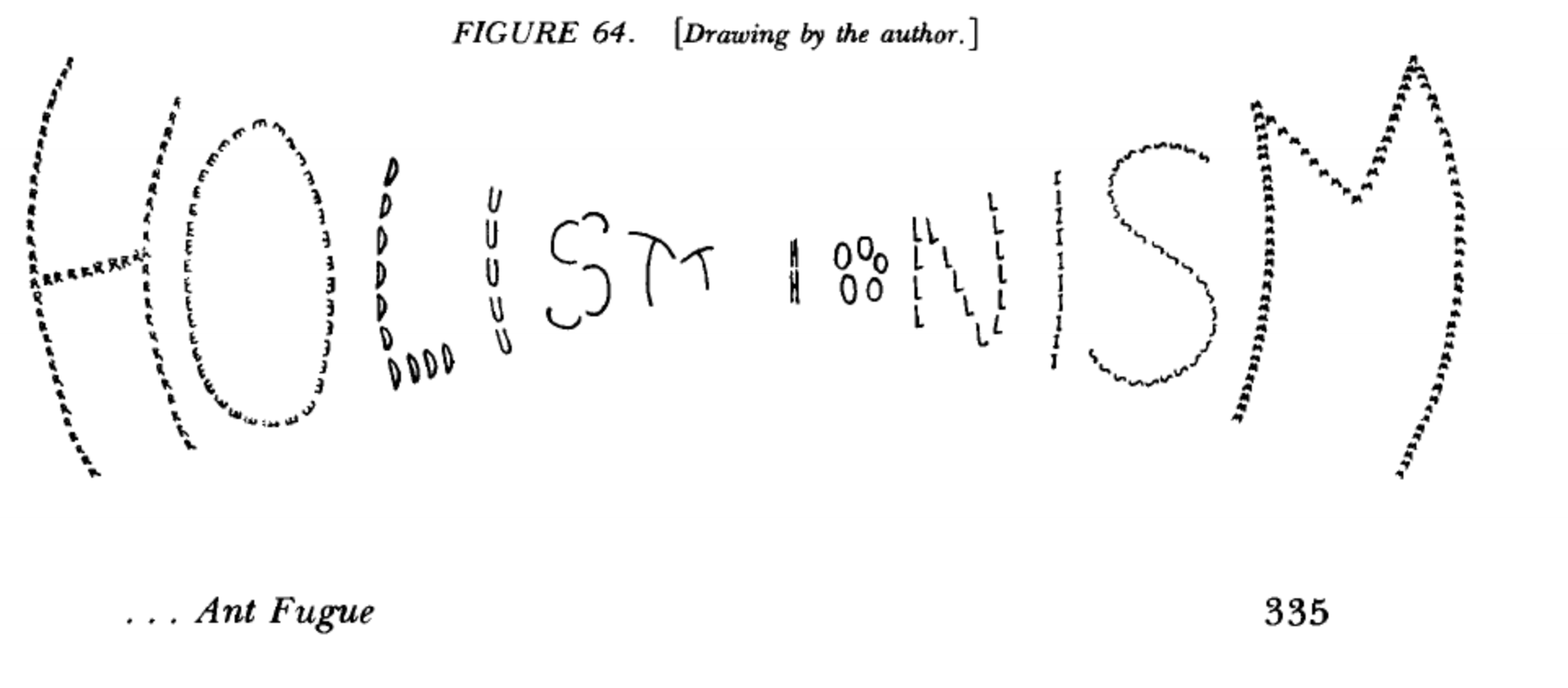
Figure 1: Figure 64 from Douglas Hofstadter's Gödel, Escher, Bach: An Eternal Golden Braid (1979), p. 335.
Content note: This essay necessarily discusses child sexual abuse and incest as implicit elements of Infinite Jest, and includes excerpts from the novel containing explicit language. The argument is speculative and text-based, but engages the subject matter directly. Reader discretion is advised.
Orin Incandenza looks, on first read, like the villain of Infinite Jest. He is cruel to animals and to his own brother; he serially seduces married mothers and abandons them before breakfast; and he retrieves his father's lethal Entertainment cartridge from the corpse's skull, disperses it to his mother's former lovers, and eventually hands the master copy to the terrorists trying to weaponize it. But Infinite Jest constantly dares its readers to subvert first impressions, and character roles blur along with everything else in a novel without a traditional plot arc.
A closer look at Orin's past, and at the last words he utters in the novel, recasts him as something closer to a victim than a villain. His apparent evil, this essay argues, is the recursive (self-feeding) product of childhood trauma, specifically the sexual abuse by his mother, Avril Incandenza. The argument is offered as an explanation, not exoneration: the cruelty Orin inflicts on others remains real, and the people he harms (Mario, his Subjects, Joelle, the recipients of the Entertainment) are not made less harmed by the fact that Orin himself was harmed first.
This essay's novel contribution to the critical literature is a typographic close-reading of one moment in Orin's morning chapter, where Wallace describes a peculiar feature of a Subject's handwritten note: "every single circle – o's, d's, p's, the #s 6 and 8 – is darkened in" (pg. 43). The argument is that the three darkened letters (O, D, P) spell, in Orin's perception, the name Oedipus. This may seem like a reach, but the encoding becomes the smoking gun in the case against Avril Incandenza when you appreciate Wallace's intellectual debt to Douglas Hofstadter and Gödel, Escher, Bach – a debt the essay documents in detail below. GEB is the foundational text in which typographic position carries semantic weight, and Wallace, per his biographer, "actually shoved this book excitedly at people in the eighties." The figure at the top of this essay is GEB's own demonstration of the move: the outer words HOLISM and IONISM are formed of twelve letters whose constituent shapes spell REDUCTIONISM, a word hidden across the morphology of two others. And the figure deepens once one sees the dialogue it sits inside. In GEB's "…Ant Fugue," Hofstadter has the Crab, the Anteater, Achilles, and the Tortoise each look at the same picture and each see a different word:
Crab: Well, what have we here? Oh, I see: it's 'HOLISMIONISM,' written in large letters that first shrink and then grow back to their original size.
Anteater: Well, what have we here? Oh, I see: it's 'REDUCTHOLISM,' written in small letters that first grow and then shrink back to their original size.
Achilles, in turn, sees HOLISM written twice; the Tortoise sees REDUCTIONISM written once. The picture is the same; the perception supplies the word. That is the o/d/p situation in miniature. The Subject's note is the picture; Orin is one of the characters; "Oedipus" is what he sees that nobody else can. Without that key, the o/d/p observation reads as coincidence, but with it, the encoding reads as Wallace marking the page with the signature of an event he did not put on it directly.
2. Orin the Apparent Antagonist infiniteJest orin
Orin is presented as a deplorable character throughout the novel. His introduction sees him being cruel to cockroaches, torturing them by suffocating them under glass tumblers (pg. 45). This is not the only time Orin is seen being remorselessly cruel to animals. Indeed, in his accident with the family dog, S. Johnson, he was unapologetic (n. 269 pg. 1050).
His cruelty to animals is reflected in a general lack of human compassion. Mario, Orin's physically disabled younger brother, often fell victim to Orin's harsh verbal cruelty (pg. 589). He chooses to liaise sexually with only married mothers, an interaction he knows harms not only the women, whom he coldly calls "Subjects", but also their children, who (especially in literature) tend to epitomize innocence (n. 110 pg. 1014-1015).
Even within the realm of this conscious act of familial corruption, Orin maintains cold detachment towards his Subjects, actively hoping they are gone by the time he awakens (pg. 46). Even before this documented mission in pursuing Subjects (see "Speedy Seduction Strategy Number [X]" n. 110 pg. 1007), Orin displayed vanity in his selection of a woman who was of "brainlocking beauty" (pg. 295). Confirming a vain motivation for this relationship, Orin cruelly relinquished Joelle around the time of her disfigurement, the precise circumstances of which the novel leaves deliberately ambiguous (pg. 795).
Finally, in perhaps the epitome of his list of crimes, Orin was the one who retrieved the lethal entertainment master copy from his father's skull, the motivation for this desecration being personal revenge (see Aaron Swartz's What Happened in Infinite Jest?). In perhaps a worse offense, he traded the Entertainment to the AFR for his life after a considerably mild technical interview (pg. 971-972).
Taken together, this evidence would make Orin the villain of Infinite Jest – cruel, vain, vengeful, reckless, and implicated in the book's central catastrophe. But read against his past, and against the specific moment near the novel's end when he breaks, these traits change shape. Two events in his life perform the shift: an abuse buried in Orin's childhood, and a technical interview by the AFR in which that past finally surfaces.
3. The First Event: Avril's Abuse of Orin infiniteJest orin avril
The first of these events is Avril Incandenza's sexual abuse of Orin. The actual occurrence of this event is implicit, and requires significant analysis to deduce. Given its fringe nature, this accusation against Avril comes with a large burden of proof. Plenty of evidence supports it.
The implication of incest between Avril and Orin first arises when Himself and Joelle's potential relationship is being discussed. Himself realizes that Avril was unbothered by the rumored affair between him and Joelle for a specific reason: she was having one of her own. The evidence which led Jim to believe this was the presence of a name written in his car window's steam (n. 80 pg. 999). Himself goes no further with this evidence than to conclude an affair was taking place between Avril and some unnamed partner. The natural curiosity to the reader, then, is the identity of the person in the car with Avril.
The text implies that the partner is Orin, and that Orin has perhaps suppressed the memory due to its traumatic nature. It comes to light (pg. 899) that "Orin alleged in YTMP that when he took the Moms's car in the morning, he sometimes observed the smeared prints of nude human feet on the inside of the windshield." At first glance, it would seem as though Orin is a third party in a potential affair, as he is 'observ[ing]' evidence of its occurrence. But his own behavior when pressed about the affair complicates this reading: n. 80 notes that Orin "would not say who or whether he knew who" was in the Volvo with Avril (n. 80 pg. 999), a conspicuous evasion for a purportedly disinterested observer. Alternative explanations exist – Orin might be protecting the family from a less lurid but still embarrassing revelation – but few of them account for the specific intensity of his avoidance. And Marlon Bain, Orin's closest friend, characterizes him to Hugh Steeply this way: "It is not that Orin Incandenza is a liar, but that I think he has come to regard the truth as constructed instead of reported" (n. 269 pg. 1048).
One might reasonably ask why the Volvo's partner must be Orin rather than John Wayne, Avril's documented student lover, and the subject of established scholarship on her sexual irregularity. The text pushes the answer toward Orin by the specific fact of how Jim learned of the affair: the Volvo anecdote is Orin's own. Orin is the source of the story about the name in the steam; and Orin, uniquely, "would not say who or whether he knew who" was in the car. Orin reporting on his mother's affair with a student teammate has no particular reason to withhold the name, while Orin reporting on his own abuse by his mother has every reason. The Wayne affair is the well-documented surface – the visible scene of Avril with Wayne. The Volvo is a different scene underneath it, and the evidence requires Orin to be the boy in the car with her.
Indeed, if one cross-references the imagery (fogged windows and footprints) used in describing the affair with the imagery used to describe Orin elsewhere, the text invites the identification of Orin as Avril's victim. The evidence is circumstantial, but it accumulates in a specific direction. The identification is a reading the text invites, not a conclusion it hands us.
What follows proceeds on the working hypothesis that Orin was in the Volvo and asks what else in the novel lines up with that reading.
4. Steam and Footprints infiniteJest orin imagery
First, in Orin's introduction, steam is an almost gratuitous motif. The general description of dampness and sweat coupled with repeated references to glass windows echoes the image of the fogged car window. His coffee's steam thinning, a sweat-soaked mustache, the chugging of a Jacuzzi, shimmering heat, mirages, a perfume spritzer, etc… all contribute to the general atmosphere of humidity seen in the car (pg. 43). Orin's technique of killing cockroaches involves inverted glass tumblers, which "gradually steam up with roach-dioxide. The whole thing makes Orin sick" (pg. 45). The image of steam is enhanced by the description of extremely hot water which immediately follows (pg. 45). The section closes with a poignant image: Orin shaving in the shower "wreathed in steam, by feel, shaving upward, with south-to-north strokes, as he was taught" (pg. 49). The closing image also nods implicitly at Himself, the teacher of against-grain shaving. The atmosphere of steam likely brings Orin back to that same atmosphere in the car with Avril, and conjures a misplaced sense of guilt towards his father.
Second, when Orin is the subject in a technical interview, he is placed under a sort of glass tumbler, like the cockroaches he kills. The glass tumbler itself echoes the car: "steam on the sides," and, in possibly this essay's most robust connection to the car scene, smeared footprints. "The glass was too thick to break or to kick his way out, and it felt like he might have possibly broken the leg's foot already trying… There were now smeared footprints on the glass" (pg. 972). These footprints on the glass walls of the tumbler parallel strikingly, in both content and diction, with the footprints Orin "alleged" earlier in the novel.
A skeptical reader will note that steam, glass, and enclosure are motifs Infinite Jest uses broadly. They saturate the Phoenix condo, fill Ennet House, and recur across the Quebec arc. The claim here is not that the imagery is unique to Orin but that its specific conjunction in his introduction, with fog plus footprints plus glass plus the mother-as-Jacuzzi-chugger and father-as-teacher-of-shaving pairing, recapitulates the car scene with a density that reads as patterning rather than accident.
5. Other Evidence for the Affair infiniteJest orin avril
Other evidence supports the incest hypothesis. Pemulis walks in on John Wayne and Avril mid-encounter in Charles Tavis's office:
John Wayne wore a football helmet and light shoulderpads and a Russell athletic supporter and socks and shoes and nothing else. He was down in the classic three-point stance of U.S. football. Inc's incredibly tall and well-preserved mother Dr. Avril Incandenza wore a little green-and-white cheerleader's outfit and had one of deLint's big brass whistles hanging around her neck (pg. 553).
The scene demonstrates that Avril has engaged in sexual contact with a teenage student at the academy she co-founded. It also, once the staging is on the page, reads as a fantasy re-enactment in which Wayne plays Orin (a football player) and Avril plays Joelle (Orin's former cheerleader girlfriend). The football helmet, the brass whistle, the green-and-white outfit, the paper pompoms on the seminar table are too specific a constellation to be coincidence.
The incestuous connection is encouraged by the narrative. Immediately before the scene Pemulis walks in on, Dolores Rusk is in her office down the hall delivering an extended psychoanalytic monologue to Ortho Stice that turns out, for several pages, to be a gloss on the Oedipus complex: "GI Joe typically being cathected as an image of the potent but antagonistic father… the Oedipal phase's desire to control the bowels in order to impress or quote 'win' the mother, of whom the Barbie might be seen as the most obviously reductive and phallocentric reduction of the mother to an archetype of sexual function and availability" (pg. 550). Wallace has placed his most explicit Oedipal exegesis a few feet from the room where Avril and Wayne are role-playing it.
Wayne's exact age during the YDAU narrative-present is one of the novel's deliberate ambiguities. The text places him at 17 or just-18 – he was "the top-ranked junior male in Canada at sixteen" the year before, and the recruitment plan has him going pro "at nineteen" (pg. 259) – and the novel never pins the date down. That ambiguity is itself part of Infinite Jest's broader practice: the text leaves Joelle's disfigurement deliberately ambiguous, leaves the Volvo partner unnamed, leaves Wayne's age on the cusp. If Wayne is 17 the Avril-Wayne affair is statutory rape; if 18, it is institutional grooming by a co-founder of the academy he is enrolled at. Both are harsh indictments of Avril's sexual irregularity. The novel withholds the difference, and the withholding does literary work: what it leaves visible is that Wayne is a teenager under Avril's authority, sexually entangled with her, his relation to consent unresolved. On this reading, Wayne in the Wayne-Avril incident is not the documented adult counterpart to a hidden Orin abuse, but instead is a parallel case. Wayne and Orin are two instances of the same predation, treated by the novel with the same studied ambiguity that keeps either from being unmistakably named.
Avril's note to Orin offers another piece of evidence, which contains obviously sexual diction: "Every floral unit on the grounds has its pistil aprick and petals atremble in a truly shameless fashion, for the bees are about." She closes the letter with the phrase "Proud, as ever, to know you." (n. 110 pg. 1006). A militant grammarian, Avril chooses her phrasing with care, and as a result, the second (sexual) entendre is difficult to read as accidental. Marlon Bain, in a correspondence with Hugh Steeply, revealed that Avril, towards her children, was "the most consummate mind-fucker" (n. 269 pg. 1048). The phrase is Bain's characterization of Avril's psychological dominion over her children, which is not, in itself, evidence of sexual abuse, but it does corroborate the broader pattern of maternal enmeshment on which this reading rests.
Finally, after Himself sees the name written in the window, presumably 'Orin' or simply 'O', he immediately films the scene in the Entertainment which depicts a mother emphatically apologizing to her son (n. 80 pg. 999). Orin's habit of leaving signature marks on partners makes him a more natural candidate for the name-writer than a hypothetical third party. One Subject is characterized in passing as "Not real bright – she thought the figure he'd trace without thinking on her bare flank after sex was the numeral 8, to give you an idea" (n. 110 pg. 1015). The trait characterological: Orin signs his work.
6. O's, D's, and P's: The Oedipus Encoding infiniteJest orin oedipus
The most direct textual figure for what happened to Orin appears in a description of his nightmares. In a paragraph which opens with the phrase "As a nod to Orin's own unhappy youth…", a dream is described in which "…Mrs. Avril M. T. Incandenza's, the Moms's disconnected head attached face-to-face to his own fine head, strapped tight to his face somehow by a wrap-around system of VS HiPro top-shelf lamb-gut string from his Academy racquet's own face. So that no matter how frantically Orin tries to move his head or shake it side to side or twist up his face or roll his eyes he's still staring at, into, and somehow through his mother's face. As if the Moms's head was some sort of overtight helmet Orin can't wrestle his way out of" (pg. 46-47). The face-to-face contact is unmistakably sexual in charge.
A few pages earlier in the same chapter, the narration had turned to the Subject's note, on which Orin believed "The only interesting thing about the script, but also depressing, is that every single circle – o's, d's, p's, the #s 6 and 8 – is darkened in, while the i's are dotted not with circles but with tiny little Valentine hearts, which are not darkened in" (pg. 43). The note, in the particular circles Orin fixates on, suggests the name "Oedipus" not as something the Subject has encoded, but as something Orin is projecting onto a neutral graphic. The morphological hook is real: O, D, and P are the circle-bearing letters of the Oedipal name, and they are precisely the letter-circles Orin's eye lands on. The darkening also includes the numerals 6 and 8, which belong to no word at all, meaning the pattern cannot be the Subject's coded spelling. It is Orin's pattern-matching, his repressed memory surfacing through a visual trigger.
A more parsimonious reading is available: the Subject simply darkens all closed glyphs as a handwriting tic, with no projection required. The projective reading depends on those numerals doing semantic work no tic explains, an argument the essay develops below for the 8 in particular. The Valentine hearts dotting the i's (not darkened in) compound the creepiness of the near-spelling: the hearts occupy the "i" positions of the word, so that a post-coital note from a maternal-figure Subject comes to Orin as "Oedipus" rendered with a heart over the self-referential "I" character. The geometry is more precise than that. "Oedipus" has seven letters, and the single i sits at position four, the exact center of the word. The valentine heart that replaces the i's dot lands at the very middle of the name Orin is reading. This is GEB's foundational move: typographic position doing semantic work, the way Gödel-numbering makes a symbol's place in a string inseparable from its meaning. The sign of romance sits at the center of the Oedipal word, just as Orin's trauma sits at the center of his romantic engagements. This is "depressing" because Orin understands, at whatever level of awareness, that he and the Greek mythological figure Oedipus have the same secret.
A reader might reasonably object at this point that the essay is forcing a physical reading onto a pathology the novel establishes as emotional. Infinite Jest characterizes Avril as controlling, enmeshing, "consummately" manipulative. Every behavior the essay has cited (the smothering, the helmet dream, the Feeding My Man passage, the bees letter) could be read as severe psychological enmeshment without any physical component. The objection is legitimate. The answer here is not that physical abuse is proven but that it is the reading which accounts for the specific shape of the evidence: the fogged-window / nude-feet parallel is a physical detail belonging to a physical event; the "Do it to her!" collapse at the technical interview is a breaking-under-torture response that protects a specific embodied memory rather than a generalized emotional wound; and Orin's repeated evasion about who was in the Volvo points at a particular person rather than an abstract pattern of maternal damage. Emotional enmeshment is a necessary condition for this reading, not a competing one. The essay argues that the enmeshment has a physical dimension the novel suggests rather than confirms.
7. Gödel, Escher, Bach, Wallace infiniteJest hofstadter
The o/d/p reading looks, on its own, like a particular kind of writerly trick: a word hidden in the morphology of other letters, a signified laundered through the shape of the signifier. That trick is not idiosyncratic to Wallace. It belongs to a specific intellectual inheritance, one Wallace took up from Douglas Hofstadter's 1979 Gödel, Escher, Bach: An Eternal Golden Braid (GEB), a book he read with enough zeal that, per his biographer D. T. Max, he "actually shoved this book excitedly at people in the eighties."
Wallace was on record about GEB in his own voice. In a 2003 interview with Dave Eggers for The Believer, he called it "a great book, but it's hard," and added that "I personally don't think Hofstadter does enough teaching of the basic concepts to make his riffs and dialogues come alive for people who didn't have a lot of basic logic and recursion-theory in college" (qtd. in Burn). He was treating GEB as a peer text – engaged enough with its argument to fault its pedagogy, fluent enough in its idiom to use "recursion-theory" as a term of art. The same year, he published Everything and More: A Compact History of Infinity, his pop-math book on Cantor's set theory; and Atlas Books had originally commissioned Wallace to write the volume on Gödel and the Incompleteness Theorems before the topic was reassigned. The publisher, in other words, saw Wallace as the natural author to popularize Gödel, which was exactly the territory GEB had defined a generation earlier.
The provenance stretches across two decades of Wallace's career. D. T. Max's authorized biography records that Wallace borrowed his father's copy of GEB; that Mark Costello, Wallace's Amherst roommate, remembered Wallace while composing Infinite Jest "going on about the 'braid' or 'fugue' shape – disparate elements making a whole"; and that Max himself treats GEB as "a predecessor to Infinite Jest, at least structurally" (Max 312 n. 6). In his 1993 interview with Larry McCaffery, Wallace was already using "recursive mechanism" as his master-term for evaluating self-referential fiction, three years before Infinite Jest's publication (McCaffery, Review of Contemporary Fiction 13.2). Three years later, in a 1996 conversation with Michael Silverblatt on KCRW's Bookworm, he confirmed the Sierpinski gasket (a self-similar fractal) as Infinite Jest's structural model. By 2003, his vocabulary had hardened: in a Boston Globe interview with Caleb Crain, he called Gödel "the devil, for math," described "Cantor's paradox" as the moment that "starts the wheel of self-reference," and tied the character of Pemulis to Gödelian incompleteness as one of the novel's "Antichrists" (Crain 2003). And in his 2004 conversation with Steve Paulson, he looked back on the philosophical terrain of his graduate years as "full of recursion, and involution, and things bending back on themselves, and various incarnations of Gödel's proof, and I think some of that kind of affected me at a spinal level" (qtd. in Burn 133).
The structural connection has support beyond the biographical record. N. Katherine Hayles, in "The Illusion of Autonomy and the Fact of Recursivity" (New Literary History 30.3, 1999), reads Infinite Jest as governed by recursive feedback loops in which entertainment systems entrap characters who cannot achieve autonomy precisely because they are inside the loop. Roberto Natalini's chapter "David Foster Wallace and the Mathematics of Infinity" in A Companion to David Foster Wallace Studies (eds. Boswell and Burn, Palgrave 2013) argues that Wallace drew on Cantorian infinity and Gödelian self-reference as structural and thematic resources throughout his career. Ryan David Mullins, in "Theories of Everything and More: Infinity Is Not the End" (Gesturing Toward Reality, eds. Bolger and Korb, Bloomsbury 2014), develops a "bad infinity / good infinity" reading explicitly indebted to Hofstadter's distinction between vicious regress and productive recursion. Most directly: Ugo Panzani, writing in Lettera Matematica International (Springer 2015), observes that the recursive iteration in Infinite Jest "proceeds to the level of typography", which is the precise level at which the o/d/p reading operates. Cory M. Hudson's 2015 MTSU thesis Gödel, Hofstadter, Wallace: The Gödelian Metalogical Narrative Structure of David Foster Wallace's Infinite Jest then develops the structural isomorphism in detail (Hudson 56-86). The braid, the fugue, and the strange loop are GEB's operative figures, and they become Wallace's formal vocabulary.
But GEB is not only a book about structural recursion; it is, persistently, a book about typography. Hofstadter's dialogues between Achilles and the Tortoise are riddled with letters encoding other letters, words hidden inside numerals, ambigrams, and Gödel-numbering (the technique by which any written statement can be translated into a single integer, so that a formal system can refer to itself through a different surface grammar). The Subject's note in Infinite Jest works in exactly that register. Orin does not read "Oedipus" on the page; he projects it, out of the morphology of circle-letters the Subject wrote for other reasons entirely. That is a Hofstadterian move: the move of finding a meaningful string inside an indifferent one, the move of self-reference laundered through surface innocuousness. When Orin registers the note as "depressing," he is doing the reader's work for us: he is experiencing, as a character, the kind of strange loop GEB taught Wallace to construct.
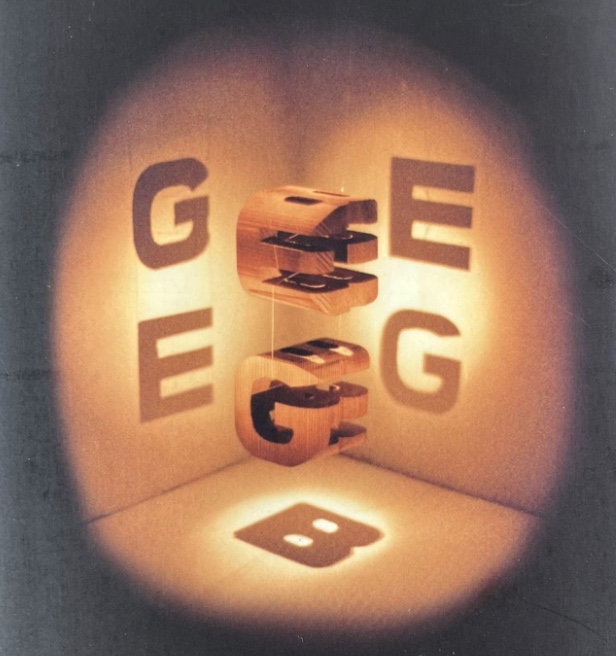
Figure 2: Hofstadter's "trip-let" construction from Gödel, Escher, Bach (1979) – a single wooden form whose shadows spell G, E, and B when lit from three orthogonal directions. The wood itself is neutral; the letters live in the projection. Orin reads "Oedipus" onto the Subject's circle-letters by the same light: the morphology on the page is indifferent, and the meaning is supplied by the angle from which Orin is looking.
What the record does not yield is direct evidence that Wallace and Hofstadter ever met or corresponded; Hofstadter, for his part, has never publicly commented on Wallace's work. Wallace's father, James Donald Wallace, was a virtue ethicist (Cornell PhD under Norman Malcolm – a prominent Wittgenstein pupil), not a formal-systems philosopher; the household intellectual lineage ran Wittgenstein-via-Malcolm rather than through Hofstadter directly. GEB reached Wallace as a pop-sci stimulus, sitting beside but not displacing the formal-philosophy training he had through his Amherst thesis on modal logic. Nor has any prior scholarship identified the o/d/p encoding specifically. The argument here is original, but grounded in well-prepared soil.
8. Letters Inside Letters infiniteJest hofstadter typography
None of this would matter if the o/d/p encoding were the only such moment in Infinite Jest. It isn't. Wallace is a typographic novelist in the strictest sense: across his thousand pages he encodes meaning in the morphology of letters, in acronyms that spell hidden words, in anagrammed proper names, in phonetic decomposition, and in self-reflexive footnote architecture. The Subject's note is one instance in a consistent practice.
- Consider James Incandenza's filmography, listed in n. 24. Wallace gives one of the films the title Möbiu$ Strips, substituting a dollar sign for the s, a single glyph that visually resembles the letter while importing a second register (commerce, pornography) into a topological loop. The technique is the same as the one on the Subject's note: a character whose shape is doing typographic work beyond the level of legibility.
- Or consider "O.N.A.N." – the Organization of North American Nations, the supranational body whose acronym, deployed relentlessly throughout the novel, spells "Onanism" (the biblical figure for spilled seed and the term for self-gratification). The reader is being asked to assemble a hidden word from morphological units, which is the o/d/p mechanism applied at the scale of a nation-name.
- Or "Pemulis," the drug-dealing E.T.A. student whose name is a perfect anagram of IMPULSE – letters rearranged to encode the character's pathology inside his own name.
- Or a credited filmography character named "Hugh G. Rection" – a phonetic decomposition that hides "huge erection" inside an innocuous-looking proper name.
Each of these moves is the o/d/p move, played in a different register.
The practice scales from individual words to the architecture of the text. Infinite Jest, the novel – contains a film called Infinite Jest, the lethal Entertainment whose existence drives the plot (listed in James Incandenza's filmography as versions I-VI, n. 24); the book is named after the artifact at the center of its own world, a structural strange loop in Hofstadter's exact sense.
Pemulis's answering-machine message extends the move into prose: "This is Mike Pemulis's answering machine's answering machine; Mike Pemulis's answering machine regrets being unavailable to take a first-order message… if you'll leave a second-order message…". This is GEB's technical vocabulary deployed inside a character's voicemail. An internal footnote in n. 304 reads "Q.v. Note 304 sub", which is a footnote pointing back at its own note, a bibliographic strange loop. Another Incandenza film is titled The Machine in the Ghost, inverting the Cartesian/Rylean "ghost in the machine"; the narration later quotes its own inversion verbatim ("A machine in the ghost, to quote a phrase"), so that the filmography and the body text cite each other across formal levels.
At the level of proper names, the practice continues. James O. Incandenza's initials spell J.O.I. (joy), the very feeling his lethal Entertainment was intended to deliver and instead poisons. "Orin" is an anagram of "NOIR," and the chapters Orin appears in are the novel's most paranoid, surveillance-soaked, genre-marked sections. Other instances are scattered throughout: Hugh Steeply's drag persona "Helen Steeply" encodes the "Paris and Helen" mythology the Marathe-Steeply dialogues explicitly invoke; Madame Psychosis's call sign "WYYY-109" is named for the fact that 109 is "the largest whole prime on the FM band" (the triple Y also reading as a question – why? why? why?); James Incandenza's production company "Latrodectus Mactans Productions" takes its name from the Latin for the black widow spider, naming his marriage's fate. In each case, Infinite Jest is doing what the Subject's note does: hiding a word inside a word, or a word inside a structure, asking the reader to recognize the embedded meaning by stepping back from the surface text. The Oedipal reading is one instance of a continuous authorial practice.
9. Orin in Translation infiniteJest hofstadter typography
Orin's name itself does similar work, at the level of translation. The strongest reading is Hebrew: Oren (אֹרֶן) means "pine tree," and appears in Isaiah 44:14 in one of the prophet's central attacks on idolatry. The passage describes a man who plants a tree, waters it, and from the same tree carves both fuel for his fire and an idol he proceeds to worship. The prophet's argument is that idolatry consists in worshipping what one has oneself constructed. That is the precise architecture of Orin's life. The football helmet, the amniotic stadium and the Subject-protocol are all built from his own trauma and then submitted to as if external. The Hebrew root names the pattern.
A second derivation, the Irish Odhrán, may supplement the reading. The name belonged to a 6th-century Irish saint, one of Columba's companions at Iona; an apocryphal but persistent strand of his hagiography holds that he was buried alive at the abbey's foundation to consecrate the ground. Whether Wallace had this particular legend in mind is unknowable, but the loose resonance is hard to miss. The Irish derivation, even taken at the level of legend, places a buried boy at the foundation of an institution, which is exactly what the essay has been arguing the Incandenza family is: an institution erected over the buried fact of what was done to its eldest son.
GEB devotes substantial attention to translation across languages, formal systems, and levels of representation. Hofstadter's recurring argument is that meaning lives at the level where these translations preserve structure, not at the level of the surface symbols. The etymology of "Orin" is exactly that kind of cross-system encoding: a name innocuous in English unfolds, under translation, into a thematic key, which visible to the reader who knows the language, and hidden to the one who does not. Wallace, characteristically, has placed the meaning where it can be missed.
10. Eight, Sideways infiniteJest hofstadter typography
There is one more typographic observation worth pausing on, and it returns the essay to the same passage we began with. The Subject's note has its darkened circles – "o's, d's, p's, the #s 6 and 8" – and the essay has so far read those as the morphology of "Oedipus." But the 8 is doing additional work the other glyphs are not. Rotated ninety degrees, "8" becomes "∞." It is the only glyph in the darkened set that is also an ambigram of the symbol for infinity.
The Subject's note, in other words, is doing the same kind of encoding work twice. The letter-circles spell Oedipus. The numerical circle, rotated, spells infinity. Together, the note encodes the Oedipal trauma in its recursive form: not only Orin's mythological status, but the strange-loop structure that keeps him traversing it. GEB is the founding text on strange loops (closed curves that cross themselves, traversed forever, never escaping). ∞ is the strange loop drawn and 8 is the strange loop hidden inside an innocuous numeral.
The same figure shows up on Orin's body. His specific signature mark, "the figure he'd trace without thinking on her bare flank after sex was the numeral 8" (n. 110 pg. 1015), is, in this light, the symbol for infinity inscribed on a Subject's body. Each new Subject receives the shape of recursion. Orin's pursuit of married mothers is, the essay has argued, a recursive trauma, a return to the original maternal scene that can never quite arrive there. The 8 is what that pursuit looks like, drawn idly, on skin, after sex. Wallace's own Everything and More: A Compact History of Infinity (2003) is his sustained engagement with Cantor and Gödel, the mathematics of recursive structures ascending into hierarchies of infinity without ever closing. When Orin traces 8 on a Subject's flank, he is drawing a structure Wallace had spent two years writing a book about. Wallace signs the page, Orin signs the body, and the signature in both cases is the same: the strange-loop figure traced on a stand-in for the original.
11. Recursive Anxiety and Redirected Hostility infiniteJest orin psychopathology
The event of Orin's sexual abuse recasts his villainy in an intuitive way: Orin is a victim of a traumatic childhood experience, and his current and past actions are products of the damage that experience instilled. The humid atmosphere of his introduction instills dread.
For Orin Incandenza, #71, morning is the soul's night. The day's worst time, psychically. He cranks the condo's AC way down at night and still most mornings wakes up soaked, fetally curled, entombed in that kind of psychic darkness where you're dreading whatever you think of (pg. 42).
"Dread" and "entombment" here describe Orin's psychological reaction to trauma. The fact that he "dread[s] whatever [he] think[s] of" speaks to his reasons for repressing, on some level, the entire car incident (this repression is seen when Orin is "alleg[ing]" the "smeared prints of nude human feet" distantly, in the 3rd person). The damage from his childhood abuse manifests as anxiety about being entrapped, under control, suffocated (it is no accident that Avril herself defensively self-describes as "un-smothering"). This is perhaps why Orin gravitates towards football, a sport in which he can escape "… as he'd never escaped himself on the court…". Football gives Orin "… a sense of a presence in the sky…" (pg. 295-296). Football, "the sound of the womb, the roar gathering, tidal, amniotic…", offers him a rebirth (pg. 295).
The anxiety dominates him. The morning passages give the imagery directly: "It's the mornings after the spider-and-heights dreams that are the most painful, that it takes sometimes three coffees and two showers and sometimes a run to loosen the grip on his soul's throat" (pg. 46). The cockroaches in the humid shower symbolize his rekindled entrapment anxiety. To subvert these feelings, he attempts to nullify them by exerting some cruel, god-like, torturous control over them.
What makes the anxiety recursive – in the precise Hofstadterian sense Wallace was already using by 1993, when he called metafiction a "recursive mechanism" that "spirals in on itself" (McCaffery, Review of Contemporary Fiction 13.2) – is that every defense Orin builds against it reproduces the conditions of the original trauma. The avoidance-behavior is itself the trigger. The cockroach scene traces the loop step by step. He tries to suppress the cockroaches (the memory) by running the shower water hot. But, alas, hot water generates steam, and steam is the texture of the fogged-up car window where the abuse occurred. He tries to trap the cockroaches under glass tumblers, but the trapped insects produce "roach-dioxide" that fogs the tumbler walls. This is the same fogged-glass signature. Every escape route returns him to the trauma. "The whole thing makes Orin sick" (pg. 45) is not surprise; it is the recognition that the trap is closed.
The same loop runs through Orin's fear of heights. Every elevation he achieves; whether in career, public visibility, or his punter's contract with Arizona; raises the height from which he will eventually tumble into the morning dread. Climbing is escape, but with Shakespearian tragicness, the higher he climbs, the more terrifying is his descent.
These worst mornings with cold floors and hot windows and merciless light – the soul's certainty that the day will have to be not traversed, but sort of climbed, vertically, and then that going to sleep at the end of it will be like falling, again, off something tall and sheer (pg. 46).
Orin also fights his anxiety more directly, whether consciously or not. His abuse of Mario is probably an arrow thrown obliquely towards his abuser, Avril, given how close Mario and Avril are; and then the S. Johnson incident was probably driven by that same logic, given how close Avril was to the dog. Presumably, the reason Orin resented Avril for forgiving the S. Johnson incident (pg. 1014) was that he had hoped it would crush her. Here, Avril reveals how deftly she 'fucks the mind'.
Orin's destructive relationship with the married-mother Subjects is another example of his attempt to control what is controlling him. That is, he targets maternal figures in an attempt to silence the control his own mother exerted over him. His callousness towards them (his desire that they be gone by the morning) is issued because they remind him directly of Avril: they ask "what exactly is the story with the foggy inverted tumblers on the bathroom floor, commenting on his night-sweats… the ones who have this thing about they call it Feeding My Man…" (pg. 46). This reminiscence of Avril is likely the reason Orin deludedly sees things like "Oedipus" ("o's, d's, p's") encoded into his Subject's note.
Perhaps Orin's biggest crime was the retrieval and dispersal of the Entertainment to his mother's previous sexual partners and his ensuing grant of the master copy to the AFR. Orin didn't do this to avenge his father's suicide; Jim and Avril "hadn't been intimate with each other, i.e. conjugally, for quite some time" (n. 80 pg. 999), so an affair wouldn't have driven Jim to kill himself. Rather, his targeting of his mother's previous sexual partners was probably an attempt to seek retribution for his own imagined complicity in what his mother had done to him. This reading departs from Swartz's, which posits the father as the target of Orin's revenge, but it better accounts for the specificity of the recipients: not Avril's enemies or Himself's rivals generally, but the men Avril slept with. Although this was reckless – catastrophically, if not apocalyptically, reckless, given the Entertainment's nuclear properties – it is psychologically intelligible from someone plagued by an intense and recursive anxiety whose source (the abuse by his mother) is the very thing at which the recklessness was aimed. Intelligibility is not absolution; the people the Entertainment was meant to reach were endangered regardless of why.
12. The Helmet infiniteJest orin psychopathology
There is a puzzle in Orin's psyche the essay should pause on. Orin's central trauma (the one his nightmares stage and his syntax disowns) is the experience of being enclosed by his mother. The helmet dream is the explicit version: "Mrs. Avril M. T. Incandenza's, the Moms's disconnected head attached face-to-face to his own fine head, strapped tight to his face… As if the Moms's head was some sort of overtight helmet Orin can't wrestle his way out of" (pg. 46-47). And yet Orin, every game, voluntarily straps on a football helmet. The trauma's exact structure, a tight enclosure of his own head, is the structure of his profession.
The puzzle resolves itself when you consider who is doing the strapping. The Avril-helmet of the dream is something done to him: he cannot wrestle his way out, the verb attached is passive, and the leather string around his face is the work of an external agent. The football helmet is the opposite kind of object: he puts it on, by his own hand, before each game, and removes it when he chooses. Counterphobia, in the vocabulary Dolores Rusk uses with Ortho Stice, is the defense by which one reproduces the structure of the feared thing under conditions of personal control, and then repeating the trauma to master it. Orin's helmet is counterphobic in exactly that sense because he has built a career out of the gesture of voluntarily closing the maternal enclosure around his head, and unbuckling it when he is done.
The football helmet sits, moreover, inside a larger chosen womb. The essay has already cited DFW's word for the stadium: "the sound of the womb, the roar gathering, tidal, amniotic" (pg. 295). Football is a controlled re-entry into the maternal space. Helmet, stadium, crowd, and team are nested enclosures, each of which is chosen, and each of which is protective. Orin has constructed a counter-mother out of professional infrastructure. The original mother smothered him; the new one is amniotic.
Then comes the technical interview. The AFR's glass tumbler is the same shape as the helmet, a tight enclosure of Orin's head and body. But it is unchosen, he cannot remove it, and he can break neither it nor the "leg's foot" trying. What is devastating about the Room 101 (read below) scene is not only that Orin breaks; it is that his entire defensive architecture has been reverse-engineered. The novel has been showing us this counterphobic apparatus all along (the helmet, the stadium, the controlled descent into womb-shape) and the AFR's interrogation chamber is the moment when the apparatus is turned back on him. The helmet that protected him for years is welded shut, and he is inside it, terrified to the point that he is willing to get relief by any means necessary, even if that means the apocalypse.
13. The Second Event: Room 101 infiniteJest orin orwell
Relinquishing the master copy to the AFR, which the reader is led to believe could result in the deaths of millions of innocent people, after a seemingly mild technical interview (see Luria P-—'s eye rolling, pg. 972), seems weak of Orin. However, this is the second event which shifts the perspective of Orin away from him as a villain. A close look at Orin's final words in the novel, "Do it to her! Do it to her!", reveals an echo of what Winston shouts in George Orwell's Nineteen Eighty-Four whilst being tortured in Room 101, the infamous torture chamber from which no one emerges unbroken. This allusion suggests that Orin's interview was not mild at all but calculated; it tapped into his most visceral fears and anxieties.
Being entombed and suffocated in steamed glass brought back vivid memories of his abuse, and the flood of cockroaches signifies a total inundation of his mind with abuse-related anxiety. Orin, like the people in Room 101, is helpless against the technical interviewer's technique. The text marks the moment his repressed memory breaks through: "When Orin had tried to kick his way out was when he'd recognized that the Subject was looking at his eyes rather than into them as previously. There were now smeared footprints on the glass" (pg. 972). Orin realizes he has lost control of the Subject and that he has become the Subject. The footprints on the glass follow immediately, marking the moment his childhood abuse surges back into conscious awareness. Under such duress, Orin's giving in is psychologically intelligible – though intelligibility is not the same as forgiveness.
Like Winston's betrayal of Julia in Nineteen Eighty-Four, his (presumed) betrayal of Joelle is the response of an ordinary person to extraordinary torture, not the act of a super-human evil. That is an explanation, not an exoneration. Joelle is endangered regardless of why he named her. The parallel is not airtight because IJ never specifies who Orin names under torture, or who "her" refers to, but Nineteen Eighty-Four's echo resonant: the man who spent the novel fleeing his mother's abuse breaks, at last, into betraying the one woman who had loved him outside that shadow.
14. Subject, Not Object infiniteJest orin language
DFW was hyper-aware of the difference a word makes. He was trained in analytic philosophy, wrote an undergraduate thesis on modal logic, and taught prose style for a living. His choice of words is deliberate. So it is worth sitting with the word Orin uses for the married women he seduces: not Object, but Subject, always capitalized – "last night's Subject," "the Subject's note," "the Subject," and, when he is on the phone giving step-by-step seduction protocols to a friend, "Picture this. Obtain a ring. As in a wedding band. So you present yourself to the Subject as visibly married" (n. 110 pg. 1007). The standard feminist critique of male sexual behavior is that men objectify women, that they flatten women into their use-value, evacuating their interiority. Orin is not doing that. He is doing something much more strange.
The word "Subject" carries several resonances, each of which inflects what he is doing in a different way.
- In research, "the Subject" is the person in an experiment, or someone whose behavior is studied under controlled conditions, and about whom data is gathered.
- In grammar, "the Subject" is the agent of a sentence, the entity performing the action. The Object is what is acted upon.
- In philosophy (Descartes, Kant, Hegel, phenomenology), "the Subject" is the experiencing self, the locus of consciousness, the counterpart of the Object out there in the world.
- In political theory, "subjects" are those under the authority of a sovereign, and are subordinates to a power.
DFW's capitalized "Subject" does all four jobs at once.
- Grammatically, Orin makes the women agents, but agents of his own ongoing narrative.
- Philosophically, he acknowledges their subjecthood, but drafts it into the service of his own.
- Experimentally, he runs a long, iterated study, with each seduction being a fresh run of the same protocol (see the "Speedy Seduction Strategy" series, n. 110), with data gathered and discarded at dawn.
- Politically, the women are subjects of his self-reproducing pathology – subordinates to a sovereign whose only real project is working out the shape of his own trauma.
Subjectification, in Orin's hands, turns out to be a subtler and more invasive violation than objectification. To objectify is to deny interiority. To subjectify, in Orin's sense, is to borrow interiority, or to enlist the other person's subjecthood as a prop for your own. The women are treated as full persons, but only insofar as being treated as full persons is useful to the work Orin's psyche is doing on itself.
The logic shows itself most clearly on the note. The Subject's note is a real artifact of her subjecthood (her script, her violet bond, her Valentine hearts) and yet what Orin reads in it is not her at all. He reads Oedipus. He reads himself. The Subject has been drafted, unknowingly, into the mirror he is using to see his own buried memory. The "depressing" feeling he registers is not about her, but rather about what her handwriting has made him recognize in himself. Her full subjecthood is exactly what makes the mirror work. An Object could not reflect him back; only a Subject could.
Then, in the technical interview by the AFR, the direction reverses. Orin, who has spent the novel using women as Subjects, becomes the Subject himself, in the capital-S, technical sense, interrogated behind glass. "When Orin had tried to kick his way out was when he'd recognized that the Subject was looking at his eyes rather than into them as previously" (pg. 972). The Subject on the other side of the glass is Luria P-—, who was once his Subject in the sexual sense; now the surface between them has flipped, and Orin is the one being studied, squeezed for data, held under conditions he did not choose. He has been the Subject the whole time, the subject of his own trauma working itself out through the bodies of other women. The technical interview is merely the scene in which the novel makes the inversion explicit. Every "Subject" Orin ever slept with was, in a sense, a surrogate Orin: the self he could not look at directly, looked at through someone else. The strange loop, in the Hofstadter sense, is that the grammar was right. He was always the Subject of the sentence and the women were the Objects. He just preferred to call them otherwise.
15. The Leg's Foot infiniteJest orin language
DFW's grammar of Orin's body is also marked, and the technical-interview passage is the place where the marking becomes most visible. Look again at the sentence the essay has been quoting:
The glass was too thick to break or to kick his way out, and it felt like he might have possibly broken the leg's foot already trying (pg. 972).
Two things are doing trauma-vocabulary work in this sentence. The first is the modal scaffolding: it felt like plus might have plus possibly is a triple hedge that puts maximum distance between Orin's reporting consciousness and the embodied event. He is not reporting that he hurt his foot, but rather is reporting that it-felt-like-may-have-possibly happened to a foot. The second is the noun phrase "the leg's foot." Not "his leg" or "his foot." Not even "the leg" with "the foot" as a separate noun. The leg owns the foot, and Orin owns nothing. The chain of dispossession runs two removes deep because the leg is alienated from Orin, and the foot belongs to that already-alienated leg.
This is the language of dissociation. Survivors of childhood sexual abuse frequently describe a trauma response in which the body is experienced as not-theirs, watched from outside, and owned by something other than the experiencing self. Wallace renders the dissociation clinically, at the level of syntax. There is no clean I connected to this body in this sentence at all. The pronoun has retreated entirely.
The grammatical retreat is sharper given who Orin is. Orin is a punter. The leg the syntax disowns is the body part on which his entire adult identity is built, the instrument of his career, the locus of his "amniotic" rebirth fantasy in the football passages, and the means by which he had organized his post-trauma life around an escape from his early-morning dread. To watch the novel disown that leg in this scene is to watch Orin lose access to the one part of himself he had organized everything around.
The same syntactic move runs through the morning chapters. He describes "his soul's throat" being under grip (pg. 46). This throat is not owned not by Orin but by his soul, with Orin reporting on the relationship as a third party. The soul's throat, the soul's certainty, the soul's night, the leg's foot: in moments of acute pressure, the grammar reaches for an intermediate possessor (like a soul or a leg) to insert between Orin and the part of him that is suffering. The intermediate noun is the grammatical residue of dissociation; it is the chain of inanimate relations that the body becomes when the self has fled it.
This is also, finally, a problem in the philosophy of mind that Wallace, via Hofstadter, was already preoccupied with. GEB takes its energy from the question of how a self inhabits a physical substrate, or the ghost in the machine, in Ryle's coinage that Wallace inverted in The Machine in the Ghost on the Incandenza filmography. The leg's foot is what the inversion looks like inside Orin's body: a chain of mechanical relations with no clean ghost left to own them. By the technical interview, Orin's strategy of interposing intermediate nouns has run out of room. There is no further owner. He is the Subject at last, but he no longer owns the body the Subject is in. The trauma is what made the leg into "the leg" to begin with. Orin's body alienated itself a long time ago, in another room, with another woman who needed not to be there. The technical interview only forces him to watch the alienation happen in real time.
16. Conclusion infiniteJest orin
Orin's deplorable behavior, on this reading, is the product of his traumatic past and its recursive anxiety. Each of the cruelties the novel attributes to him admits an explanation that does not require inherent evil. The cockroaches are a memory he can neither suppress nor face. S. Johnson and Mario are plausibly indirect targets of hostility he cannot aim at Avril directly. The married-mother Subjects are both a search for his mother and a revenge upon her, which is why he is cold to them at breakfast. Leaving Joelle after her disfigurement was overdetermined – superficially a vanity collapse, but plausibly compounded by the familial echoes her relationship with her father stirred up that day. Dispersing the Entertainment targeted the men Avril slept with, not, as Swartz argues, an avenging of Jim.
Taken together, these behaviors describe a victim as well as an antagonist. The thesis does not exonerate Orin – he does real harm, and the harm is real. It argues only that his role as the catalyst of the post-text conflict is the aftermath of childhood sexual abuse, not the expression of any super-human evil.
What makes the reading possible at all is the o/d/p trick, and what makes the trick legible is GEB. Without Hofstadter, the darkened circles read as coincidence; with him, they read as Wallace doing exactly the kind of work GEB taught him – meaning encoded in the morphology of marks rather than in their assigned content, recoverable only by a reader who knows where to look. The Subject's note is the place where the novel marks its own page with the signature of an event it cannot otherwise put on it. Every other piece of evidence the essay has assembled – the Volvo, the Wayne parallel, the helmet dream, the leg's foot, the Room-101 betrayal – is corroboration of what the o/d/p trick names directly.
17. Glossary glossary
- Aaron Swartz
- Programmer, activist, and early Infinite Jest critic. His 2009 essay What Happened in Infinite Jest? proposes a reconstruction of the novel's post-text plot. This essay's Event-Two reading explicitly departs from Swartz's father-as-revenge-target account.
- AFR
- Les Assassins des Fauteuils Rollents ("the Wheelchair Assassins"), the Québécois-separatist terrorist cell pursuing the Entertainment.
- Avril
- Orin's mother, formally Avril Incandenza (also called "the Moms" or "Mrs. M. T. Incandenza" in the novel). Co-founder of E.T.A., Québécois Catholic immigrant, prescriptivist grammarian. Confirmed in a sexual relationship with E.T.A.'s John Wayne – a relationship established scholarship treats as the primary textual evidence for her sexual irregularity, beneath which this essay argues a deeper layer.
- DFW
- David Foster Wallace, the author of Infinite Jest and the subject of this essay.
- Dolores Rusk
- E.T.A.'s staff counselor and on-site psychologist. Conducts therapy sessions in which she expounds, sometimes comically, on psychoanalytic theory; her discussion of the Oedipus complex with Ortho Stice immediately precedes the Pemulis/Avril/Wayne scene.
- Entertainment
- Shorthand in Infinite Jest for James Incandenza's final, fatally compelling film cartridge – the film whose viewers cannot stop watching.
- E.T.A.
- Enfield Tennis Academy, the elite tennis school co-founded by Avril and James Incandenza, where most of the novel's E.T.A.-side action takes place.
- GEB
- Gödel, Escher, Bach: An Eternal Golden Braid, Douglas Hofstadter's 1979 Pulitzer-winning book on self-reference, recursion, and strange loops – a foundational influence on Wallace.
- Himself
- Family nickname for James O. Incandenza, Orin's father (also "Jim"). Optical physicist, experimental filmmaker, and founder of E.T.A.; creator of the Entertainment cartridge whose effect drives the novel's plot. Kills himself by microwaving his own head before the main narrative opens; the Entertainment's master copy is subsequently retrieved from his skull.
- Hofstadter
- Douglas Hofstadter (b. 1945), American cognitive scientist and author of Gödel, Escher, Bach (1979). His work on self-reference, recursion, and strange loops is the formal-system framework this essay reads Wallace against.
- Hugh Steeply
- Office of Unspecified Services operative investigating the Entertainment. Typically works in (unconvincing) female disguise. His correspondence with Marlon Bain supplies the Bain letters this essay quotes.
- IJ
- Infinite Jest, David Foster Wallace's 1996 novel.
- Joelle
- Orin's girlfriend of twenty-six months, formally Joelle van Dyne; the so-called "Prettiest Girl Of All Time" (P.G.O.A.T.). After Orin leaves her she becomes muse and lead for James Incandenza's final, lethal film. Disfigured under circumstances the novel leaves deliberately ambiguous; later wears a veil and broadcasts as "Madame Psychosis" on MIT student radio. This essay frames her as Orin's Julia in the Room-101 betrayal structure.
- John Wayne
- E.T.A.'s top-ranked male tennis player, formerly of Montcerf, Quebec; Avril's secret student lover. In the YDAU narrative-present he is 17 or just-18 – an age the novel leaves deliberately ambiguous. This essay reads him as plausibly a parallel victim to Orin rather than Avril's adult co-conspirator.
- Julia
- Winston Smith's lover in Nineteen Eighty-Four, betrayed by him under Room-101 torture. This essay casts Joelle as Julia's structural analog in Orin's collapse.
- Luria P----
- Member of the AFR (full name Luria Perec, of Lamartine, county L'Islet, Quebec). Appears female-presenting as one of Orin's Subjects and then as co-operative at his technical interview; her eye-rolling at the AFR leader's theatrics is the gesture Orin misreads as the interview being "mild."
- Mario
- The middle Incandenza brother (Mario Incandenza), born with severe congenital disabilities and a documentary-filmmaker's temperament. Avril's favorite – which this essay argues is exactly why Orin's verbal cruelty toward him functions as displaced hostility toward their mother.
- Marlon Bain
- Orin's closest friend from the E.T.A. tennis years, later debilitated by a psychosomatic hyper-perspiration disorder. His correspondence with Office of Unspecified Services agent Hugh Steeply is the source of the "most consummate mind-fucker" characterization of Avril and the claim that Orin "constructs rather than reports the truth."
- Oedipus
- Mythological king of Thebes who, fulfilling an oracle, unknowingly killed his father Laius and married his mother Jocasta; source of Freud's "Oedipus complex." This essay argues Orin's fixation on the note's darkened circle-letters o/d/p reflects an inadvertent Oedipal self-recognition.
- O.N.A.N.
- Organization of North American Nations, the supranational confederation Infinite Jest invents. The acronym, deployed relentlessly throughout the novel, spells "Onanism" – one of Wallace's typographic encodings.
- Orin
- Orin Incandenza, the eldest of the three Incandenza brothers, a former E.T.A. tennis prodigy who switched to football at Boston University and became a punter (#71) for the Arizona Cardinals. The subject of this essay.
- Ortho Stice
- ("The Darkness") E.T.A. tennis player ranked #3, from rural Kansas, dressed exclusively in black. Therapy-session interlocutor of Dolores Rusk.
- Pemulis
- Michael Pemulis, E.T.A. student, mathematical and navigational savant, and the Academy's de facto pharmacist. Hal Incandenza's closest friend. His accidental discovery of John Wayne and Avril mid-encounter in Charles Tavis's office is one of this essay's pieces of evidence.
- P.G.O.A.T.
- Prettiest Girl Of All Time, Joelle van Dyne's nickname.
- S. Johnson
- The Incandenza family dog, named after the English lexicographer Samuel Johnson. Killed in an "accident" involving Orin; the circumstances surface in n. 269. This essay reads Orin's indifference to the dog's death as an indirect attack on Avril.
- Subjects
- Orin's chosen term for the married women he seduces (always capitalized, "the Subject," "last night's Subject"). This essay reads the terminology as deliberately marked: not objectifying but subjectifying – borrowing each woman's interiority as a prop for his own.
- Winston
- Winston Smith, protagonist of George Orwell's Nineteen Eighty-Four (1949). Broken in Room 101 under the threat of having rats set on his face, he shouts "Do it to her! Do it to her!" – the same phrase Orin shouts at his technical interview, anchoring this essay's Event-Two allusion.
- YDAU
- Year of the Depend Adult Undergarment, the principal year of Infinite Jest's narrative-present. In the novel's near-future, calendar years are subsidized to corporate sponsors.
- YTMP
- Year of the Tucks Medicated Pad, one of the subsidized years preceding YDAU.